+506 2216 0222
paesa@iica.int


DID YOU KNOW?
-
Over 64% of affected farmers use Prodesal
More than 64% of the affected farmers were enrolled in Prodesal and received technical guidance and support. -
Five communes hold 50% of affected farmers
50% of the 1,056 affected farmers were concentrated in five Maule communes: Chanco, Cauquenes, Pelluhue, Parral and Retiro. -
Maule records 1,056 affected farmers
1,056 farmers affected by the frontal weather systems were recorded by INDAP in the Maule Region as of the week of 7 August 2026.
Family Farming
Resources
(290 records
)
Events
(31 records
)
Evidences
(345 records
)
Over 64% of affected farmers use Prodesal
More than 64% of the affected farmers were enrolled in Prodesal and received technical guidance and support.
Five communes hold 50% of affected farmers
50% of the 1,056 affected farmers were concentrated in five Maule communes: Chanco, Cauquenes, Pelluhue, Parral and Retiro.
Maule records 1,056 affected farmers
1,056 farmers affected by the frontal weather systems were recorded by INDAP in the Maule Region as of the week of 7 August 2026.
More recent in politics
Investments and Public Expenditure
(616 records
- USD 162,496,848,490.00
)
Emergency food production support for vulnerable families in Haiti
Emergency programme implemented by FAO in ten municipalities across the Haitian departments of Artibonite, Centre and Ouest to restore local food production and meet urgent needs. The first phase reaches 13,000 vulnerable households, representing approximately 65,000 people. With funding exceeding USD 16 million, the programme is expected to ultimately support 326,000 people by providing farming households with more than 205 tonnes of crop and vegetable seeds and over 160,000 small livestock. The second phase will distribute ducks, poultry, guinea fowls, rabbits and goats to more than 29,394 households to facilitate immediate access to food and protein, protect livelihoods and reduce reliance on recurring humanitarian assistance.
Peru: Budget Program 0121 - Improving Small Agricultural Producers' Access to Markets
Budget Program 0121 seeks to improve the integration of small and medium-sized agricultural producers into markets and address their limited market access. Created in 2014, it contributes to productivity, competitiveness, sustainability, inclusion, and food security in Peru. MIDAGRI's General Directorate for Agricultural and Agroecological Development is the technical entity responsible for the program.
Productive recovery of farmers affected by the frontal weather system in the Valparaíso Region
An INDAP Valparaíso intervention to restore the productive units of farming families affected by the July 2026 frontal weather system. The initiative finances the rehabilitation of productive infrastructure, particularly greenhouses, storage building roofs and livestock pens, and includes specialized technical assistance in soil preparation, irrigation, fertilization and agronomic management. Actions are focused mainly on the provinces of Petorca and Quillota, with additional attention in Marga Marga, San Felipe, San Antonio, Los Andes and Casablanca.
Policy frameworks
(676 records
)
Peru: Emergency Decree No. 106-2021 authorizing financial subsidies for producers purchasing fertilizers
Emergency Decree No. 106-2021 authorizes Peru's Ministry of Agrarian Development and Irrigation to grant financial subsidies, channeled through the AGROPERÚ Fund, to producers who purchased fertilizers during the 2021-2022 agricultural season and operate agricultural units of between two and ten hectares. The decree authorized a PEN 250,947,734 public budget transfer to finance the subsidies, AGROPERÚ Fund financial expenses and MIDAGRI operating expenses, in support of agricultural production and food security.
Supreme Decree No. 011-2024-MIDAGRI approving the Regulations of Legislative Decree No. 1077, which created the Competitiveness Compensation Program
Approves and regulates the implementation of Legislative Decree No. 1077, which created the Competitiveness Compensation Program (AGROIDEAS), with nationwide scope. The regulation seeks to increase the competitiveness of organized small and medium agricultural producers and their associations through incentives for associativity, business management, agricultural technology adoption, organizational strengthening, and the implementation of bio-businesses and eco-businesses, under social, environmental, and economic sustainability criteria.
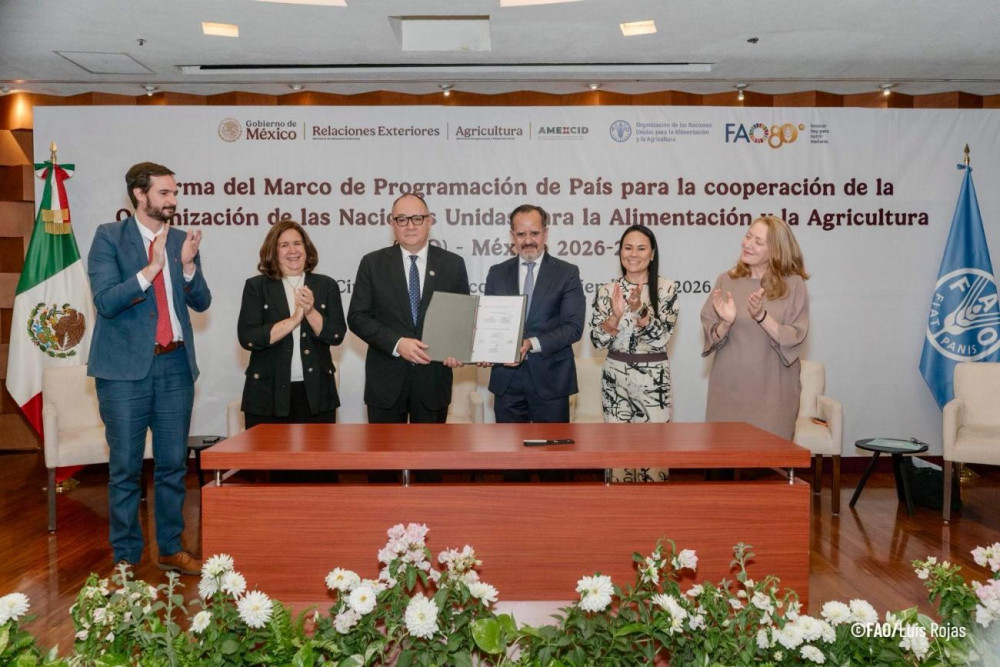
Mexico-FAO Country Programming Framework 2026-2031
The Mexico-FAO Country Programming Framework 2026-2031 guides the priorities, goals, and mechanisms for technical and financial cooperation between the Government of Mexico and the Food and Agriculture Organization of the United Nations over six years. Its purpose is to accelerate the transition toward more efficient, inclusive, resilient, and sustainable agrifood systems. It organizes cooperation around the dimensions of people, prosperity, and planet and includes actions related to productivity, nutrition, finance, technology, markets, public procurement, short supply chains, sustainable management of water, soils, forests and fisheries, social protection, gender equality, and productive inclusion. Its six results areas represent a portfolio of approximately 140 million dollars for 2026-2031, of which about 54 million dollars already have identified funding and 86 million dollars must be mobilized. Implementation will be jointly monitored by SRE, SADER, AMEXCID, and FAO.
Good practices
(53 records
)
Rural Enterprise and Agricultural Development Project (READ)
Project implemented in six regions of Guyana to improve the social and economic conditions of poor rural households, especially small-scale producers and vulnerable groups. READ expanded access to financial services and strengthened enterprise and market development, technical assistance, extension and training. The target group comprised 5,200 rural households, equivalent to about 20,800 people, with particular attention to woman-headed households, youth, Amerindian communities, non-traditional crop farmers and operators of rural micro and small enterprises. The Ministry of Agriculture was the executing agency and IFAD provided both loan and grant financing.
Hinterland Environmentally Sustainable Agricultural Development Project – HESADP
An agricultural and community resilience project to address climate variability, droughts, floods, dry spells, and saline intrusion. It integrates climate-smart farming, infrastructure, community businesses, and extension services
Conservation and Sustainable Use of Agro-biodiversity to Improve Human Nutrition in Five Macro Eco-regions (Bolivia)
Project aimed at conserving agro-biodiversity in situ across five macro eco-regions and improving the livelihoods of local populations. It seeks to mainstream the valuation, conservation and sustainable use of agro-biodiversity into national policies, regulatory frameworks, and health, education, rural development and food security programmes. It includes the generation of market incentives and awareness-raising and training processes for the sustainable management of natural resources.
PAESA in Focus
(3 records
)