

We are PAESA
IICA’s platform for strategic analysis and action, helping strengthen public policies and institutions across agrifood systems in the Americas by promoting evidence-based interventions.
Background
The Inter-American Institute for Cooperation on Agriculture (IICA) is the specialized agency for agriculture of the Inter-American System that supports the efforts of its Member States to promote agricultural development, food security, and the well-being of rural populations through technical cooperation. With the approval of the 2026-2030 Medium-term Plan (MTP), the work previously carried out through the Observatory of Public Policies for Agrifood Systems (PAESA) has been strengthened and expanded through the Platform for Strategic Analysis and Action on Public Policies and the Institutional Framework of Agrifood Systems (PAESA), as part of IICA's technical support services for technical cooperation.
With the approval of the 2026-2030 Medium-Term Plan (MTP), the work previously carried out through the Observatory of Public Policies for Agrifood Systems (PAESA) is being strengthened and expanded via the Platform for Strategic Analysis and Action for Public Policies and the Institutional Framework of Agrifood Systems (PAESA), as part of the technical support services for IICA's technical cooperation.
This change preserves and builds on the capacities developed through PAESA for the observation, systematization, and management of information on public policies and agrifood systems, while expanding its scope to incorporate greater capacity for strategic analysis and thinking, the generation of evidence-based policy proposals, support for the formulation of concrete actions, interventions, and investments, and the design and management of financial and economic instruments.
PAESA thus builds upon the work carried out by OPSAA, but with a strengthened, more action-oriented mandate aimed at helping to improve public policies, institutional frameworks, spending, and investment related to the agrifood systems of the Americas.
The 2026-2030 MTP organizes IICA's technical cooperation around four hemispheric programs: Science, Technology and Innovation for Productive Development; International Trade, Regional Integration and Agribusiness; Agricultural Health, Biosecurity, and Food Safety and Quality; and Strategic Natural Resources for the Productivity and Resilience of Agrifood Systems. PAESA provides cross-cutting support to these programs by generating information, analyses, and proposals aligned with the priorities and needs of countries.
The PAESA Platform
The PAESA online platform is one of the instruments used to organize, integrate, and make available information and knowledge on public policies, investments, institutional frameworks, and the performance of agrifood systems in the Americas.
Its structure makes it possible to connect policies, institutional frameworks, information, indicators, evidence, and experiences, creating a knowledge base for analysis and evidence-based decision-making.
The platform also facilitates the exchange of information and knowledge among countries, IICA specialists, and other public, private, academic, and international cooperation actors, supporting the identification of challenges and opportunities and the development of relevant responses for agrifood systems.
PAESA's Main Functions
PAESA performs four main functions:
- Observation and management of information and knowledge
Serve as a specialized observatory and an agile, permanent repository of up-to-date information on public policies and institutional development related to agrifood systems and to the areas of work of IICA's technical cooperation programs. - Strategic analysis and thinking
Conduct analyses and generate strategic thinking on public policies, their results, and their effectiveness in different contexts, as well as on the need to strengthen sector institutions. These analyses seek to support the definition of relevant evidence-based actions and interventions, identify emerging challenges, and help anticipate needs and opportunities. - Proposals for actions, interventions, and investments
Support IICA's technical cooperation programs and its Representations in the countries in developing proposals for concrete strategic actions, interventions, and investments aimed at improving public policies and the institutional framework of agrifood systems. - Financial and economic instruments
Contribute to the design and management of financial and economic instruments that can improve the performance of agriculture and agrifood systems and encourage changes toward more efficient, profitable, resilient, and sustainable production models. These instruments may include, among others, economic incentives, conditional payments, sustainability standards, carbon and biodiversity markets, and conditional credit and insurance mechanisms.
The topics addressed by PAESA are flexible and respond to the priorities and needs of countries and IICA’s technical cooperation programs. They include both current and emerging policies, as well as public and private investment proposals.
PAESA’s work is action-oriented: information and analysis are intended to be translated into concrete proposals for policies, interventions, and strategic investments that contribute to improving the effectiveness of public expenditure and strengthening the institutional framework of agrifood systems in the Americas.
PAESA in Numbers
Methodology - Information processing at PAESA
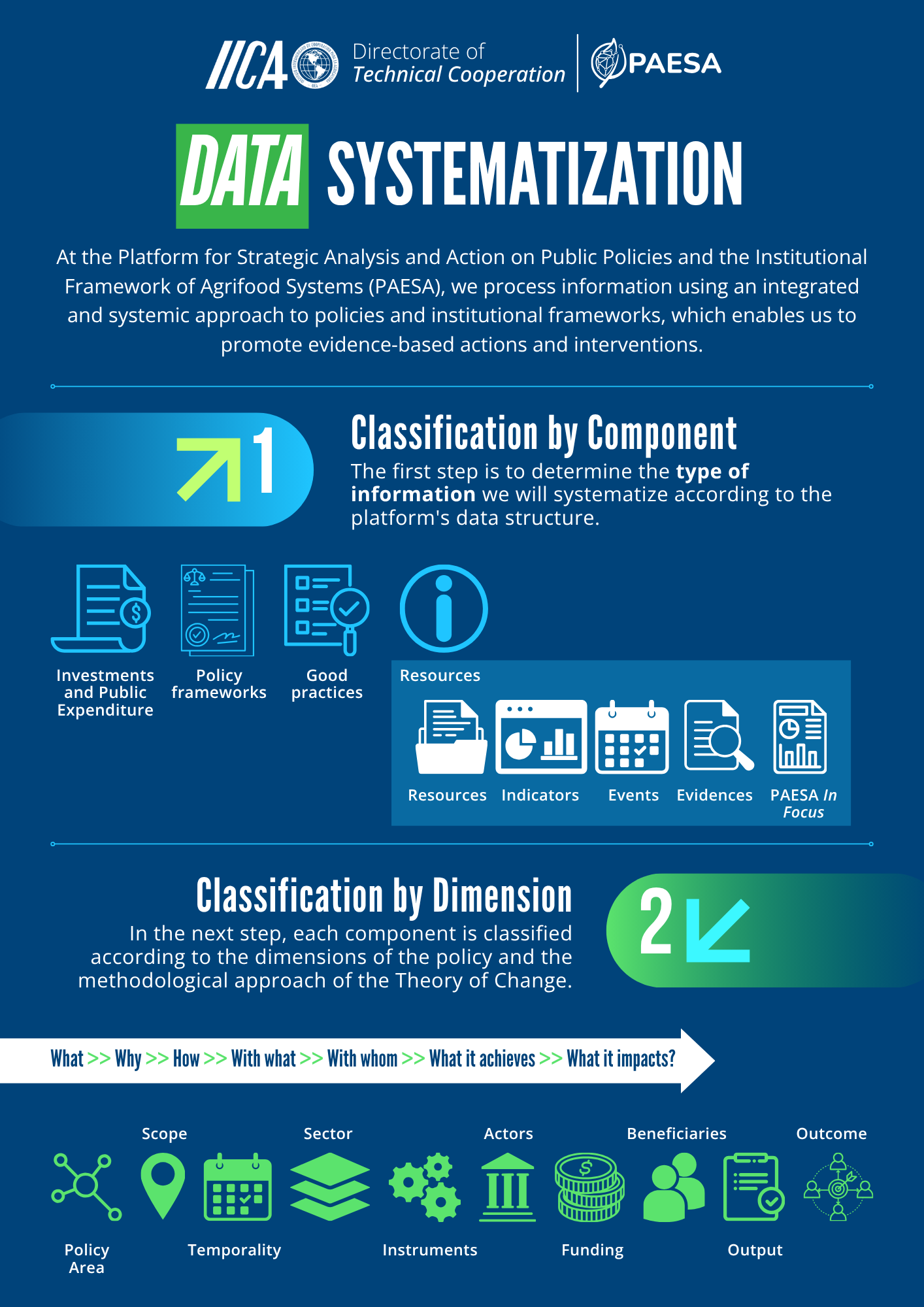
Information entered into PAESA is initially classified according to the eight components that make up the observatory (initiatives, policy frameworks, good practices, indicators, information resources, events, evidence, and PAESA in Focus) and subsequently according to the ten policy dimensions detailed below. Data are recorded in an integrated database, ensuring that no elements within PAESA exist in isolation; instead, they are all interconnected. This enables a systemic approach to information and knowledge management, allowing for diverse perspectives, entry points, and pathways for exploring the information.
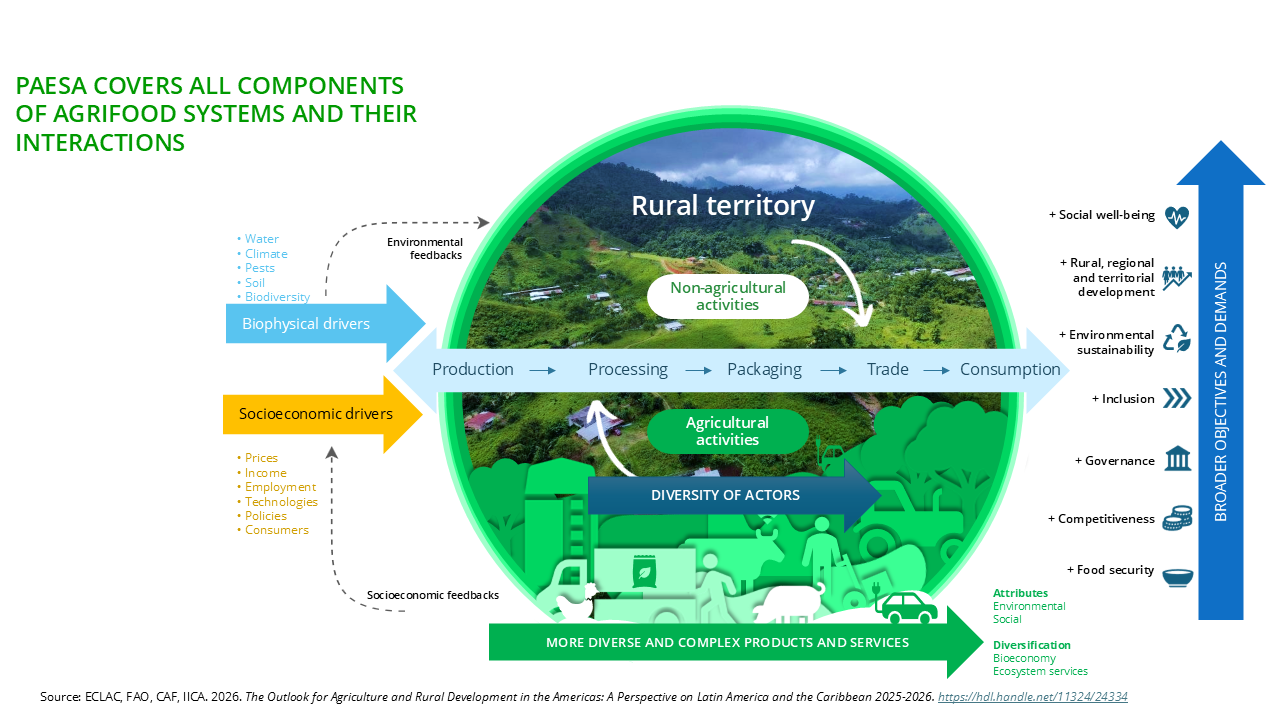
The content systematized in PAESA encompasses the main elements and interactions that make up agrifood systems (AFS). Unlike other observatories, PAESA enables users to access information on public policies related to their various components, without limiting the scope to the primary agricultural sector.
Agrifood systems encompass the full range of actors, processes, and activities associated with the production, processing, packaging, marketing, and consumption of agricultural and food products, as well as agricultural and non-agricultural activities taking place in rural territories.
These systems are characterized by a growing diversity of actors and by the diversification and increasing complexity of products and services, including environmental and social attributes, bioeconomy activities, and ecosystem services. Their activities, outcomes, and interactions are influenced by biophysical and socioeconomic drivers and, in turn, generate feedback effects on those environments.
Agrifood systems also respond to an expanding set of objectives and demands, including social well-being, rural and territorial development, environmental sustainability, inclusion, governance, competitiveness, and food security.
While the transformation of agrifood systems is essential, it is not sufficient on its own to ensure sustainable development. Agrifood systems are also territorially embedded and operate across interconnected spatial scales, from the local to the global.
Continuing with the presentation of the PAESA content, the information is organized into eight components that make up the data structure within the observatory, namely:
- The policy initiatives are interventions that can take the form of laws, guidelines and incentives, among others, reflected in allocations of public or private resources. This component receives special attention, since a large share of policies in the region are not put into concrete instruments; priority is therefore given to those with an explicit public budget allocation, which in turn specifies the instruments used to achieve the results set out in the policy.
- The policy frameworks are the legal basis for State action, expressed in guidelines, strategies, regulations, resolutions or agreements at the international, regional, national and subnational levels. PAESA prioritizes the recording of policy frameworks that underpin the design and implementation of the initiatives mentioned in component one.
- The good practices in policy management are understood in PAESA as those public policy experiences that have generated outstanding impacts and results and serve as a reference for scaling up within countries and across the region. This component records metrics on the relevance, effectiveness, efficiency and sustainability of policies, as well as lessons learned.
- The indicators component is included in PAESA to show a selection of metrics on progress, trends, and the links between the impacts, results and outputs of public policies. This component is not intended to compete with other systems available on the market; rather, it carefully selects the metrics that are relevant for monitoring the results and impacts of the actions taken by States and regional entities to modernize or improve agrifood systems (AFS). In addition, the "Agrifood Atlas" subcomponent offers a country- or region-level overview of the macroeconomic, trade and environmental context of agrifood systems in the Americas.
- The resources information component seeks to build a bridge between PAESA and other information systems relevant to policymakers, or that include content related to the design and implementation of public policies, as well as studies or data that support evidence-based policy management processes. Resources include other observatories of interest, analytical documents, news, virtual platforms, databases and scientific publications, among others.
- The events and workshops recorded in PAESA must be related to discussion activities and topics of interest regarding public policy for AFS.
- In addition, the evidence component is the format used in PAESA to report facts and specific, objective information backed by data, statistics or formal studies on the current and future state of AFS, as well as the results and impacts achieved through the implementation of policies and their instruments.
- Finally, PAESA in focus are spaces designed to facilitate the operation of policy networks that form around specific current or long-term topics. These virtual spaces provide tools to bring together all PAESA content relevant to evidence-based dialogue, as well as to facilitate the exchange of future perspectives and good public policy management practices on current or long-term issues.
Policy Dimensions
As mentioned previously, there are no isolated elements, but rather all are interconnected, following a systemic approach to managing information and knowledge. PAESA adds value through the analysis and linkage of data and information across the dimensions of policy.
Each of the policy components is characterized by the dimensions, which follow the approach of the Theory of Change and respond to questions such as: What is expected to be achieved?, What are the instruments used?, Who are the actors that participate and what role do they play?, Who are the beneficiaries? and What are the sources and types of financing? Each dimension is detailed below:
- Results: Allow correlations to be made between activities, inputs, products, results and impacts of the policy. Some examples of results are food and nutrition security, competitiveness, and animal disease control.
- Geographic: Refers to the scope of action of the policies, allowing actions to be linked at the local, national, regional, hemispheric and global levels.
- Intertemporal: Refers to whether interventions are short, medium or long term.
- Beneficiaries: These are the target populations or distinctions made by the State in its interventions for populations that require greater attention.
- Instruments: This is the set of forms of intervention and how regulations are combined with, or complemented by, market and non-market incentives.
- Financing: This is the allocation of budgets and the combination of local, national and international public-private sources, classified by type of financing, whether public budgets, debt, private capital, self-financing or international aid.
- Sectoral: this dimension makes it possible to specify whether interventions are aimed at specific sectors, products or chains, or whether they are multisectoral or cross-cutting in nature.
- Actors: In addition to recording the actors that take part in the policy in their different roles — planning, implementation, evaluation, financing or technical assistance — over time it will be possible to map networks of people and institutions, national and international, that participate throughout the policy cycle or with which there will be many opportunities for exchange and learning.
- Contextual: The contextual dimension makes it possible to record the legal bases, laws, regulations, guidelines, agreements and treaties underpinning the interventions or policy initiatives implemented, which may be national, regional or international.
- Impact: Finally, the impact dimension of policies is reflected in PAESA within the good management practices component, in terms of relevance, effectiveness, efficiency and sustainability metrics for interventions, as well as in the record of lessons learned.
In addition to the policy dimensions detailed above, PAESA's work is organized around 18 policy areas, selected according to criteria of relevance for improving agrifood systems (AFS) and because they are strategic for IICA's technical cooperation. Organizing the work by areas or topics such as climate change resilience, bioeconomy, trade and regional integration, the One Health approach, etc. makes it possible to decentralize the operation and coordination of PAESA activities, since for each topic there can be a person at IICA responsible for ensuring the integrity and quality of the information presented.
Through the Policy Dimensions menu, greater recognition is given to networking with strategic partners at the national and regional levels, making this type of work more visible and easier to find.

See more dimensions by country, policy area, sector, beneficiary, instrument and financing type.
About IICA
The Inter-American Institute for Cooperation on Agriculture (IICA) is the specialized agency for agriculture of the Inter-American System that supports the efforts of the Member States to achieve agricultural development and rural well-being.
We provide cooperation through close and permanent work with our 34 Member States, whose needs we attend to in a timely manner. Without a doubt, our most valuable asset is the close relationship we maintain with the beneficiaries of our work.
We have vast experience in topics such as technology and innovation for agriculture, agricultural health, food quality and safety, international agricultural trade, family farming, rural development, natural resource management and bioeconomy.
For more details on our hemispheric vision, mission and actions, visit us at www.iica.int